Sunday, 24 June 2012

Anya's First Holy Communion

Anya had been preparing for her First Holy Communion for months, and when the day finally arrived she was full of excitement. I will never forget the wide smile on her face that morning. Her whole being seemed to exude a joyful enthusiasm. This was her turn to receive Jesus in the Eucharist, the most important sacrament in the life of the Catholic.

May had generally been a wet month in England, but fortunately that day the weather was fine and dry. There was a large turnout, including children and their families, for the special mass at St Matthias Church in Worcester Park. There were obviously many people there who did not normally go to church. Nithya, Anya and I sat on a specially reserved bench near the altar along with Mum and Dad. Some of our close friends including our immediate neighbours joined us in the bench behind.

I thought the service went very well. Much credit goes to Fr. Kevan, the catechists and the choir. In his sermon, Fr. Kevan held up a famous allegorical painting (known as “The Light of the World”) by the English painter William Holman Hunt. It depicted Jesus knocking at an overgrown and long-unopened front door. We are like the person living in the house. Jesus always knocks at the doors of our hearts, but only we can choose to let Him in.

After mass, there was a small party for all the children in the church hall. We did not stay for that as we had arranged a special celebration for Anya at a local Italian restaurant called Positano. Some of close friends and cousins joined us for that.

Due to problems I had earlier with another restaurant, I half dreaded some last minute problem. My anxiety proved to be unfounded as the party turned out to be a grand success. The portions were generous and the service good. What was important to me was the atmosphere: it was joyful and but in keeping with the significance of the occasion. There were some people there who were not even Christians, let alone Catholics.

I was pleased with the way everything went. I enjoyed the mass as well as the party. All the work in planning and organising the event paid off. The celebrations befitted the occasion, which was an important one in Anya's life.


I made a short speech before the meal in the restaurant. This is what I said:
Ladies and gentleman, boys and girls. I’d like to thank you for coming today to celebrate Anya’s First Holy Communion. I know some of you have come long distances. There are people here from Birmingham, Coventry and Hertfordshire. So thank you for coming. We appreciate it. I hope you will enjoy the food today. A special thanks to Emilio and his staff for making all this possible.

Now we all need food, food of different kinds. The body needs material food, the mind needs intellectual food, and our spiritual life needs spiritual food.

Jesus said: “I am the living bread which came down from heaven; if any one eats of this bread, he will live for ever; and the bread which I shall give for the life of the world is My flesh.”

To us Catholics, the Eucharist or Holy Communion plays a central role in our lives. In many it recreates the Last Supper when Our Lord instituted the Eucharist. It is the THE sacrament, and all other sacraments are enriched by it. Give us this day our daily bread. Jesus loved us so much that He wanted to be with us and within us, and that is the reason for the Eucharist.

So that is why this is a memorable day in Anya’s life. She has been preparing for it for the last few months, going to her communion classes every week and learning what it all means. We are proud of her. She is a talented girl and she brings a lot joy in our lives. Her catechist, Sr. Sheila, said she is a budding theologian. A few months ago she wrote some lovely lines about Jesus. I just want to read to you what she wrote:

“Jesus is like a delicate petal. Everything He does is perfect. How can anybody be bad to Him? He is the light of the world. I love Him deep down in my heart. He will lead us in the right path.”

That’s not bad for an eight year old. We are pleased that the seed of faith is planted within her. In time we hope it will grow and blossom and make her into a lovely, caring, considerate and responsible girl.

Thanks once again. Enjoy the meal.

Sunday, 22 April 2012

A miraculous escape

This account relates to an incident which occurred on 25 January 2012.

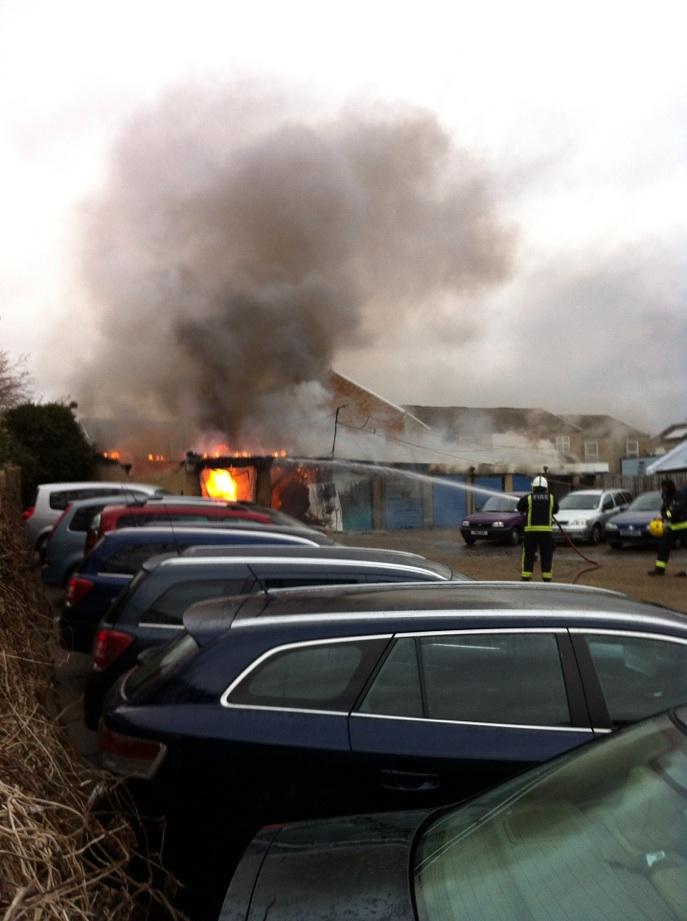
It seemed just like another ordinary working day. Everything was proceeding as normal until around 3pm the telephone at my desk rang. It was my wife Nithya. She said there was a fire at Evans Autos, a car dealership firm, very close to our house. Our road, as well as the main round around Evans Autos, was blocked off. Thick black smoke, billowing out from the fire, hung in the air around the vicinity. It was obviously a major incident. Nithya was going to take Anya, our daughter, and stay at my parents’ house. She said she would call me later when she gets more information.

Fire behind Evans Autos
My heart sank and I began to worry. Would our house be burnt down? That disastrous thought filled me with grief and anxiety. We had spent the years after getting married in that house and losing it would mean losing a great part of our life. There was nothing to do but pray quietly. I asked God for His protection. My mind disturbed and distressed was unable to concentrate again on my work. The minutes seemed to pass by a lot more slowly.

Nithya phoned again at 5pm from outside our road. Her voice sounded calm and I heard some chuckling in the background. That gave me hope that the fire was under control and our house would be saved. Nithya said she didn’t know how long it would be before our road would be opened again. So she would go back to my parents’ house and wait there.
Our house in the background
I finished work slightly earlier than usual. As I drove back home, I heard about the incident on the traffic news on the radio. That confirmed that this was a major incident. Still I was hopeful. I reached our road at 6pm. It was no longer blocked off. There was the smell of smoke all around, but seeing my house still standing and undamaged filled me with great relief. Tears of joy welled up in my eyes as I opened the front door of my house. I stood in front of the picture of Jesus in the living room and thanked Him for saving my house. It seemed like a miraculous escape.

Looking out of the window in the bedroom on the first floor, I saw how close the fire had been - just several yards away on the other side of the wooden fence at the end of the terrace. The fire had engulfed a set of small garages that had been standing there. There were still some firemen in the area making sure any remaining fire was completely extinguished.

View from bedroom window shows destroyed garages
The next day I learnt more about the incident. The fire took hold around 2.30pm, and as many as six fire engines and thirty firemen were called out to put it out. The smoke could even be seen from a few miles away. By any standards this was a major incident.

Things could have happened very differently and I could be recounting a very different tale today. For that I am grateful to the fire services and, most importantly, to God. As my neighbour commented a few days later, there really seemed to be an element of divine intervention is this incident. This only convinced us to persist with our daily Rosaries and prayers, for this world is such an unpredictable place.

Sunday, 18 March 2012

Grand Mufti of Saudi Arabia calls for the destruction of churches in the Arabian Peninsula

Can you imagine the Archbishop of Canterbury or even the Pope calling for the destruction of mosques in Europe? You can expect the predictable outcry that would cause. Most of the Muslim world and the Western media will erupt into a frenzy of heated criticism, with usual shrill cries of ‘bigot’ and demands for apologies. Yet the recent remarks by the Grand Mufti of Saudi Arabia, Sheikh Abdul Aziz bin Abdullah, that churches in the Arabian Peninsula should be destroyed have gone almost unnoticed. Only a few media organisations like Russia Today have given this any publicity.

The Grand Mufti made his controversial remarks in response to a question from a Kuwaiti NGO, the Society of the Revival of Islamic Heritage. He cited the Prophet Mohammed, who said the Arabian Peninsula should exist only under one religion. Of course, in Saudi Arabia the Mufti already has his way because there are no churches there. The Saudi government has never allowed the construction of any church in the country or for non-Muslims to meet and worship.  Other Gulf States do allow some Christian worship but with very strict restrictions in place.

What the Grand Mufti said will have an impact. He is not some marginal figure but the chief religious authority of Saudi Arabia, one of the main centres of Sunni Islam. His remarks should therefore be taken seriously.

Compare the reaction to the Grand Mufti’s remarks and the outcry over one obscure American pastor last year. It seemed as though the future of world peace was at stake when Pastor Terry Jones threatened to burn a Koran. Never mind he had a following of only about thirty people. Even Western leaders like President Obama stepped into the controversy with all the accompanying apologetic handwringing.

Can we expect David Cameron, Barrack Obama or Hillary Clinton to issue similar criticisms of the Grand Mufti’s remarks or even speak about the plight of Christians in Saudi Arabia? I doubt it very much. The American and British elites have very close relations with their Saudi counterparts, the House of Saud. In return for oil, America provides Saudi Arabia with a security guarantor; and despite a terrible human rights record, Western leaders are careful not to criticise Saudi Arabia publicly. Even the official report into the 9/11 tragedy was heavily redacted so as not to offend Saudi Arabia from where most of the hijackers came from.

All this highlights the issue of “reciprocity,” which Pope Benedict XVI has constantly talked about. As Fr Alexander Lucie-Smith says in the Catholic Herald, reciprocity means “effectively that Muslims should grant to Christians the same freedoms that Christians grant to Muslims. Just as the Italian state has allowed the building of a mosque in Rome, our holy city, so should we be allowed to build a church in Riyadh or even Mecca.”

It may be highly optimistic to expect to see a church in Riyadh or Mecca, but I don’t think it is unreasonable to at least question the controversial remarks made by the Grand Mufti. Just as Muslims are allowed to freely worship in non-Muslim countries, Christians should have every right to worship in Muslim countries.

Wednesday, 29 February 2012

Rich people less likely to be honest says study

People from wealthy backgrounds are more likely than poorer people to break laws while driving, take lollies from children, and lie for financial gain, a United States study says.

The seven-part study by psychologists at the University of California Berkeley and the University of Toronto analysed people's behaviour through a series of experiments.

For instance, drivers of expensive vehicles were observed to be more likely to break the rules at four-way intersections, and were more likely to cut off pedestrians trying to cross the street than drivers of cheaper cars.

In another test using a game of dice, given the opportunity to win a prize, people who self-reported high socio-economic status were more likely than the rest to lie and say that they had rolled higher numbers than they actually had.

People with higher status were also less likely to tell the truth in a hypothetical job negotiation in which they were the employer trying to hire someone for a job they knew was soon to be eliminated.

And when given a jar of lollies that they were told was for children in a nearby lab - though they could take some if they wanted - the richer people took more lollies than anyone else.

Also, in that particular study, researchers conditioned some of the subjects first to think of themselves as of a higher social rank by asking them to compare themselves to others with less.

The exercise showed that people could be trained to think more highly of themselves, and that they would in turn act with more greed and less ethicality, demonstrating that status drives greed.

'Culturally shared norms'

The study, which appears in the Proceedings of the National Academy of Sciences, theorises that a series of factors "may give rise to a set of culturally shared norms among upper class individuals."

For instance, richer people are more independent from others and are therefore less concerned with what others think of their actions than poorer people, the authors suggested.

According to Dr Piff, people with more money tend to look more positively on greed and rely less on family and friend networks for support in times of need, and this elevated status tends to disconnect them from society.

"It is that very different level of privilege in your everyday life that gives rise to this independence from others, this reduced sensitivity to the impact of your behaviour on others' welfare, and the prioritisation of your self-interest," he said.

Certainly there are exceptions, said the study, pointing to famous upper-class whistleblowers at Worldcom and Enron; and wealthy philanthropists such as Bill Gates and Warren Buffett.

Previous research linking poverty and violent crime also disproves the notion that all poor people are more ethical than the rich, it added.

However, self-interest is "a more fundamental motive among society's elite, and the increased want associated with greater wealth and status can promote wrongdoing," it said.

Although the study focused on US subjects, with each of the seven parts measuring between 100 and 200 participants, Dr Piff said the findings are likely to be relevant to societies outside America, too.

"These patterns are going to be particularly salient in societies where wealth is as unequally distributed as it is here," he said.

Source: ABC

Thursday, 19 January 2012

Christians targetted in Syria

The Christian community in Syria has been hit by a series of kidnappings and brutal murders; 100 Christians have now been killed since the anti-government unrest began.

A reliable source in the country, who cannot be identified for their own safety, told Barnabas Fund that children were being especially targeted by the kidnappers, who, if they do not receive the ransom demanded, kill the victim.

And the source provided detailed information – some of which cannot be made public for security reasons – about incidents that have taken place since Christmas. Two Christian men, one aged 28, the other a 37-year-old father with a pregnant wife, were kidnapped by the rebels in separate incidents and later found dead; the first was found hanged with numerous injuries, the second was cut into pieces and thrown in a river. Four more have been abducted, and their captors are threatening to kill them too.

On 15 January two Christians were killed as they waited for bread at a bakery. Another Christian, aged 40 with two young children, was shot dead by three armed attackers while he was driving a vehicle.

These latest reports are reminiscent of the anti-Christian attacks that have become commonplace in Iraq since the 2003 US-led invasion, and heighten concerns about the future for Christians in Syria as the anti-government protests there continue.

Syria pivotal in regional power battle

Several expert commentators are calling into question the narrative being spread by Western media about the nature of the unrest in Syria. They argue that it is not merely an internal conflict between the government and the rebels but has become an international battle for the balance of power in the Middle East.

Aisling Byrne, writing for Asia Times Online on 5 January, argues:
What we are seeing in Syria is a deliberate and calculated campaign to bring down the Assad government so as to replace it with a regime 'more compatible' with US interests in the region… Not for the first time are we seeing a close alliance between US/British neo-cons with Islamists (including, reports show, some with links to al-Qaeda) working together to bring about regime change in an 'enemy' state.
The battle for the regional balance of power pits an alliance of the US, Israel and the Sunni Muslim states of Saudi Arabia, Qatar and the Gulf against the Shi’a regime in Iran and Hizbollah, the terrorist organisation that it sponsors. Syria is integral to Iran’s position, and, says Saudi King Abdullah, “Other than the collapse of the Islamic Republic itself, nothing would weaken Iran more than losing Syria”. Much of the conflict is being driven by Saudi Arabia and Qatar, who are now repeating in Syria what they have done in Tunisia, Egypt and Libya to establish a Sunni Wahhabi Salafist entity, thus intensifying the pressure on Iran.

A Western-backed military campaign in alliance with the Syrian rebels against the Assad regime is looking increasingly likely, and this could be devastating for the Church in Syria. Christians in Syria have enjoyed a considerable measure of freedom and protection under President Assad; if he falls, there could be a repeat of the tragic near-extermination of the Church in post-Saddam Hussein Iraq.

On 6 January, 2012, the Council of Evangelical Churches in Baghdad was dissolved, signalling another nail in the coffin for Christianity in Iraq. The once sizeable Christian minority there has been reduced to no more than a few hundred thousand today.

Dr Patrick Sookhdeo, International Director of Barnabas Fund, said:
The Christian community in Syria is already suffering as a result of the unrest there and this will surely only intensify in the event of Western-backed military intervention. Christians in the West should not stand by and allow their governments to destroy Syria – and the Syrian Church – in pursuit of their own political interests in the region. I urge Christians not to accept blindly all the mainstream media reports about this conflict but to read for themselves the carefully considered arguments of dissenting voices (links below). And we must pray that the Lord will protect His people in Syria from a repeat of what happened to the Church in Iraq following the illegal US-led war. When Barnabas Fund carried stories about the horrific anti-Christian violence in Iraq post-2003, there were many sceptics who did not believe us. Today, this is accepted reality.
Source: Barnabus Fund

Saturday, 7 January 2012

Keeping Nigeria in our prayers

Over the last few years Fr George from Nigeria has been a regular visitor to my local church. He usually covers for the parish priest, Fr Kevan, while he has a break in the summer. Fr George is a dedicated and learned man. He studied in Rome and has an impressive theological knowledge. His affable nature, dedication and piety have made him popular among parishioners.

Back in Nigeria, Fr George is the head of a seminary. Since he is still a young man this is quite an achievement. I’m pleased to say he has become a good family friend over the years. He has visited my house a few times and we have had interesting discussions. It’s always a pleasure to talk to someone who is intelligent, offers good advice and shows Christ-like compassion. I like to keep in contact with him via email.

Fr George is based in northern Nigeria, which is generally poorer the south. While the north is predominantly Muslim the south is mainly Christian. Over the Christmas period a number of churches were attacked by the militant Islamist group Boko Haram (“Western education is sin”). The group, which has suspected links to al Qaeda, is fighting to create an Islamic state ruled by Sharia; it exploits the differences within the country as well as the failings of the government.

Fortunately Fr George and his family members were not harmed in the church attacks. The situation, however, remains tense. Added to the sectarian tensions are economic woes. Nigeria should be a prosperous country because of it’s oil reserves, but corruption is so rampant that wealth stays in the hands of a small elite. In his latest email to me, Fr George said:
“On 1st January 2012, we woke up to the rude shock of the Federal government withdrawal of subsidy on petrol by 130% and immediately the cost of goods and services rose by that same percentage at the least. There is right now, proposed indefinite nationwide strike from next Monday. The strike will further paralyse the economy. The problem is the government is not ready to tackle corruption... Every goods in the market has doubled in price. There is serious outrage. If nothing is done immediately, I am afraid the military might come back to governance in the pretext of protecting the internal territorial integrity of the nation. Life is terribly bad for Nigerians.”
We will remember Fr George and Nigeria in our prayers. We hope and pray that things improve in Nigeria, peace returns and there is a reduction in corruption.

Wednesday, 14 December 2011

"I love Jesus"

My wife asked our eight year old daughter what Christmas meant to her. She replied it meant the birth of Jesus. Since she liked drawing, my wife asked her to draw something to do with Jesus.

She thought of a petal. Puzzled by this idea my wife asked her, "Why a petal?"

"Because Jesus is perfect like a petal," she replied.

She drew some flowers on a piece of paper and coloured them in. Then in the middle of the paper she drew a heart and within that she wrote these words:


Jesus is like a delicate petal.
Everything He does is perfect.
How can anybody be bad to Him?
He is the light of the world.
I love him deep down in my heart.

He will lead us in the right path.


Don’t you think these are wonderful words to describe Jesus? They capture a child's innocent love for Him.

When my daughter asked my wife whether Jesus was proud of her, my wife replied "Yes". I’m sure He is, and so am I.