Sunday, 26 August 2012

A trip to Vailankanni

Vailankanni is the place where the Virgin Mary is believed to have appeared to two poor Indian children over 400 years ago. It is situated on the south eastern coast of India in the state of Tamil Nadu. So popular has this shrine become today that it is known by many as the “Lourdes of the East”. Every year it attracts millions of pilgrims. They come from near and far and from all different walks of life - rich, poor, able and disabled - and from different castes, creeds and religions. This is remarkable in a country where only a small fraction of the population is Christian.

Statue of Our Lady of Vailankanni at Matha Kulam
I had visited Vailankanni before as a young teenager, but I did not enjoy that trip. I was sick at the time and I had little knowledge of Our Lady’s apparitions in Vailankanni.  However, in recent years, having learnt more about the events associated with Our Lady of Vailankanni, I decided to make another trip there with my wife and daughter on our next visit to India. How would it compare to other more famous Marian shrines like Fatima and Lourdes?

Just as in Fatima and Lourdes, Mary appeared to two poor young children, bereft of great talents and well acquainted with suffering. These were the chosen instruments by which God decided to act. Initially only a small thatched chapel stood at the site of Mary’s second apparition. Then with the arrival of shipwrecked Portuguese sailors - fervent believers in Mary – the thatched chapel was replaced by a modest brick chapel. In the twentieth century the chapel was extended further, and in 1962 it was finally raised to the exalted status of a Minor Basilica by Pope John XXIII. Thus the shrine gained implicit approval from the Church for the apparitions of the Virgin Mary.

Matha Kulam

Our Lady's Tank Church
It was a long overnight journey by bus across the breadth of Southern India to Vailankanni from Kerala. We arrived at 5.30am on the first Saturday of August. After checking into our hotel, where we rested for a while and breakfasted, we started our tour of the shrine. It was a warm sunny morning. We walked along a narrow road to Matha Kulam (“Our Lady’s Tank”) where Mary first appeared. I saw small houses and nondescript buildings, and we passed some untethered goats along our way. One could sense that poverty was still a reality of the area alongside the hotels, restaurants and shops.

At Matha Kulam there was a small church, known as Our Lady’s Tank Church, built over the site of the first apparition to a shepherd boy. Once there had been a pool here, and the water drawn from this place is still believed to the source of many miraculous cures. There was a store where people could buy holy water, holy oil and candles. I could see there was a lot of demand for these things.

Holy Path & pilgrims

The Holy Path with some pilgrims crawling on their knees
As we walked down the Holy Path that led to the basilica, I saw some pilgrims crawling on their knees in the sand. This act of penance I have also seen in Fatima. Some pilgrims had tonsured their heads as another act of penance. Alongside the path were depictions of the Stations of the Cross.

There were a good number of pilgrims. The Malayalam mass was just finishing when we arrived at the basilica and a great number of people came out. We attended the English mass at 10am. It was nice to finally sit inside the church, partake in the mass and receive the Holy Eucharist. That day was the feast of St John Vianney and the priest paid special homage to him in his sermon.

Basilica

Front of basilica
The basilica is a lovely white building built in Gothic style. It has high domes and contrasting red tiles on the roof. The basilica complex doesn’t contain just one church but different ones within it, having been extended at various times. In the brilliant sunshine the basilica looked a magnificent site.

After mass, I went to the Shrine Depot near the front of the basilica. There one can buy all sorts of religious souvenirs and paraphernalia. I also made a visit to the Museum of Offerings. Here are exhibited various items people have sent as offerings to Our Lady of Vailankanni. With these items were letters written in their native languages expressing gratitude for the help they believed they received through the intercession of Our Lady of Vailankanni. Some offerings, including golden jewellery, looked very expensive.

By this time, Anya and Nithya were tired. With the hot sun beaming down on us and our faces dripping in sweat, we decided to return to our hotel for some rest and lunch. Later on, while Anya and Nithya were asleep, I went out again on my own to Matha Kulam. There I sat in the church and prayed.

Car procession

A statue of Mary and Infant Jesus being carried
In the evening I joined the car procession with other pilgrims. This involved a statue of Our Lady and Infant Jesus being carried from the basilica to the seafront and back while prayers were recited. The proximity of the basilica to the sea became evident for me. How the building avoided major damage when the tsunami struck in 2004 seemed almost miraculous.  The car procession was followed by the Blessing of the Sick, Benediction and mass in Tamil. After visiting the old church and the Adoration & Reconciliation Chapel, we finally returned to our hotel. The next morning, at 7.30am, we were on the bus again back to Kerala.

Final thoughts

I enjoyed my visit to Vailankanni. I had set out to visit the sprawling basilica, pray, experience the atmosphere and reflect on my life and God. For those reasons my trip was accomplished. I found the experience spiritually refreshing and I will cherish it for a long time. To be honest, Vailankanni is not everyone’s cup of tea. The heat, sand and crowd can be uncomfortable; the water has been known to cause stomach upsets; but if one is careful and has a genuine interest all these things are not insurmountable.

What Vailankanni demonstrated to me was the great love people had for Mary, seeking the divine consolation only she diffuses, and their desire to pay respect to the Queen of Heaven who decided to set her feet upon its soil in the sixteenth century. If it wasn’t for her apparitions there, Vailankanni will probably still be an obscure remote seaside town in Southern India. Indeed, just as in Fatima and Lourdes, Vailankanni has been transformed over the years into a major pilgrimage destination. Despite the very real challenges the Church in India today faces, this shows how vibrant it is.

Saturday, 21 July 2012

Book review: The Israel Lobby and U.S. Foreign Policy by John J. Mearsheimer and Stephen M. Walt

This book by John J. Mearsheimer - Professor of Political Science at the University of Chicago - and Stephen M. Walt - Professor of International Relations at the Kennedy School of Government at Harvard University - is excellent for anyone interested in reading about the powerful and highly influential Israel Lobby in the United States. Despite the fierce criticism any critical discussion of Israel tends to attract, I think the authors have done a creditable job researching the subject and presenting their views as objectively as possible. They state from the beginning that they do not question Israel’s right to exist, but argue that the Lobby’s influence has grown over time and is now largely responsible for the unconditional nature of America’s support for Israel. Indeed, there is no other country that receives the huge amount of aid – financial, military and diplomatic – that Israel gets from America. Yet the policies pursued by the Lobby and supported by successive American governments have not always had a positive influence on US foreign policy (or Israel for that matter).

After detailing the various forms of aid the United States gives to Israel, the authors question whether Israel today is more of a liability to America rather than a strategic asset. Certainly Israel was an asset during the Cold War, but that no longer seems to be the case with the collapse of the Soviet Union. Disproportionate support for Israel is "undermining relations with other US allies, casting doubt on America’s wisdom and moral vision, helping inspire a generation of anti-American extremists, and complicating US efforts to deal with a volatile region." Israel also looks first and foremost to its own interests, and it has done things contrary to American interests. The various moral arguments supporters employ to justify America’s special relationship with Israel are examined and undermined.

A spot light is shone on the different components that make up the Lobby. It is not a single unified movement with a central leadership but a "loose coalition of individuals and organisations that actively work to shape US foreign policy in a pro-Israel direction." The majority of the Lobby’s constituents are Jewish, but there are also some important non-Jewish individuals and groups such as the Christian Zionists. The Lobby generally promotes a very hawkish Israeli position – more extreme than most Jewish Americans – yet this has become more pronounced over time.

What makes the Lobby so effective? There are various reasons say the authors: it is well financed and resourced; American Jews are politically very active and give generously to political parties; dissent is mainly a private affair; and the Lobby has the support of the neoconservatives and Christian Zionists. But the main reason, according to the authors, is that there is no effective opposition to it. Arab Americans are neither as wealthy, well organised, numerous or politically active as Jewish Americans.

The peculiarities of the American political system are what make the Lobby such an influential force. Since elections in America are expensive affairs, the Lobby’s main way of influencing politics is by way of donations. The Lobby, in particular AIPAC, screens candidates based on their views of Israel. Then it donates money to candidates that are pro-Israel. Candidates who aren’t pro-Israel can expect funds channelled to their opponents. The Lobby has also had success in turning round politicians who have been critical of Israel into steadfast supporters. An example is Hillary Clinton. Sometimes a bit of threatening behaviour is used by AIPAC toward politicians who fail to follow its lead. Such is AIPAC’s hold on Congress today that to be invited to speak at its annual Policy Conference has become a coveted affair among prominent politicians.

A chapter is devoted to how the Lobby influences the media and think tanks, policies academia and uses the charge of anti-Semitism to silence critics of Israel. There are individual chapters on the role of the Lobby behind various modern day phenomena such as the Israeli-Palestinian conflict, the invasion of Iraq, the Second Lebanon War, Israel’s tense relationship with Syria and the Iranian nuclear programme. In all these cases the Lobby has played a prominent role – more prominent than I had hitherto thought. America’s increasingly confrontational approach to Iran is partly as a result of pressure from the lobby, which views a nuclear armed Iran as a mortal threat to Israel’s existence; the authors say this is despite the fact that Iran did try to reach out to the US and normalise relations, notably in 1997 and 2003, and helped America topple the Taliban in 2001.

The book ends with the authors suggesting ways in which the US could have a more balanced foreign policy less influenced by the Israel Lobby. These include: maintaining a regional balance of power (‘offshore balancing’) by supporting local allies instead of unilateral transformation, ending the Israeli-Palestinian conflict by supporting a two-state solution, treating Israel as a normal state, and a more open discussion about US interests and Israel. These are good suggestions, but it is difficult to see most of them happening any time soon.

On the whole this a very interesting book, which I enjoyed reading. I agree with Mearsheimer and Walt that US foreign policy is tilted heavily in favour of Israel and the Lobby has a large part to play in this. Given America’s dependence on oil from Arab states, its strong support for Israel can only be adequately explained by such a powerful force, small though it is. The book is not a diatribe, but a sensible and intelligent piece of work. It’s clear the authors have researched their subject thoroughly; their arguments are backed up well and presented logically. It will not please the diehard Israeli supporters, but for others this is a valuable addition to the discussion about the power of the Israel Lobby and its influence on US foreign policy. I certainly learnt a lot from reading it and I recommend it to others.

Wednesday, 4 July 2012

India's "impossible" miracles

By Marco Tosatti

Strange things are going on in the diocese of Itangar, Arunachal Pradesh in north-east India, and Bishop John Kattrukudiyil spoke about them during a visit to Germany for the periodic meeting organised by Aid to the Church in Need, the international organisation that deals with churches and Christians in countries where they face the greatest difficulties.

According to the prelate, the numerous unexplained healings which preceded and resulted from prayer, are the main reason for this extraordinary increase in Catholics - 40% over 35 years - in this remote corner of India. The bishop is informed of things like this on a regular basis; and the stories “baffle me. I have a theological mindset and it is easy to become sceptical about this kind of thing. But the interested parties are absolutely convinced that what happened to them was real.”

The prelate mentioned the case of a man who stopped persecuting the Catholic Church after he married a Catholic girl. “After converting to Catholicism he was asked to pray for a paralytic. He did it even though he did not want to; the next day, the paralytic rose and walked towards the church.”  The newly converted man was so shocked by this miraculous experience that he started attending mass and “is now a very active member of the parish.”

Bishop Kattrukudiyil is well aware of the scepticism with which most of these miracles are met; when he describes miracles that have taken place people in Europe sometimes say: “Hey, bishop, you’re telling tales.” But despite the incredulity “I am told about many cases of healing which we cannot ignore.”

One possible historical- theological explanation is the relative freshness of the local church. “It is the experience of a very young Church that feels the grace of the Catholic Church in the times of the apostles,” when healing miracles were frequent, as the Scriptures tell us.

According to the prelate, the faithful of his diocese witnessed these miraculous healings after gathering in the home of a sick person whom they had been praying for. “People who had been sick for a very long time were healed. These people got a real experience of the primitive Church.” During the early Church period “healing with God’s prayer attracted many people to the Church. Belonging to the Church they felt a kind of spiritual peace.” The bishop revealed that the number of Catholic faithful has grown by 40% over the past 35 years. The situation in the Church has improved a great deal; now, not only is it tolerated, but it is praised for its philanthropic work. “Politicians never miss an opportunity to praise the Church for its humanitarian work.”

Source: Vatican Insider

Sunday, 24 June 2012

Anya's First Holy Communion

Anya had been preparing for her First Holy Communion for months, and when the day finally arrived she was full of excitement. I will never forget the wide smile on her face that morning. Her whole being seemed to exude a joyful enthusiasm. This was her turn to receive Jesus in the Eucharist, the most important sacrament in the life of the Catholic.

May had generally been a wet month in England, but fortunately that day the weather was fine and dry. There was a large turnout, including children and their families, for the special mass at St Matthias Church in Worcester Park. There were obviously many people there who did not normally go to church. Nithya, Anya and I sat on a specially reserved bench near the altar along with Mum and Dad. Some of our close friends including our immediate neighbours joined us in the bench behind.

I thought the service went very well. Much credit goes to Fr. Kevan, the catechists and the choir. In his sermon, Fr. Kevan held up a famous allegorical painting (known as “The Light of the World”) by the English painter William Holman Hunt. It depicted Jesus knocking at an overgrown and long-unopened front door. We are like the person living in the house. Jesus always knocks at the doors of our hearts, but only we can choose to let Him in.

After mass, there was a small party for all the children in the church hall. We did not stay for that as we had arranged a special celebration for Anya at a local Italian restaurant called Positano. Some of close friends and cousins joined us for that.

Due to problems I had earlier with another restaurant, I half dreaded some last minute problem. My anxiety proved to be unfounded as the party turned out to be a grand success. The portions were generous and the service good. What was important to me was the atmosphere: it was joyful and but in keeping with the significance of the occasion. There were some people there who were not even Christians, let alone Catholics.

I was pleased with the way everything went. I enjoyed the mass as well as the party. All the work in planning and organising the event paid off. The celebrations befitted the occasion, which was an important one in Anya's life.


I made a short speech before the meal in the restaurant. This is what I said:
Ladies and gentleman, boys and girls. I’d like to thank you for coming today to celebrate Anya’s First Holy Communion. I know some of you have come long distances. There are people here from Birmingham, Coventry and Hertfordshire. So thank you for coming. We appreciate it. I hope you will enjoy the food today. A special thanks to Emilio and his staff for making all this possible.

Now we all need food, food of different kinds. The body needs material food, the mind needs intellectual food, and our spiritual life needs spiritual food.

Jesus said: “I am the living bread which came down from heaven; if any one eats of this bread, he will live for ever; and the bread which I shall give for the life of the world is My flesh.”

To us Catholics, the Eucharist or Holy Communion plays a central role in our lives. In many it recreates the Last Supper when Our Lord instituted the Eucharist. It is the THE sacrament, and all other sacraments are enriched by it. Give us this day our daily bread. Jesus loved us so much that He wanted to be with us and within us, and that is the reason for the Eucharist.

So that is why this is a memorable day in Anya’s life. She has been preparing for it for the last few months, going to her communion classes every week and learning what it all means. We are proud of her. She is a talented girl and she brings a lot joy in our lives. Her catechist, Sr. Sheila, said she is a budding theologian. A few months ago she wrote some lovely lines about Jesus. I just want to read to you what she wrote:

“Jesus is like a delicate petal. Everything He does is perfect. How can anybody be bad to Him? He is the light of the world. I love Him deep down in my heart. He will lead us in the right path.”

That’s not bad for an eight year old. We are pleased that the seed of faith is planted within her. In time we hope it will grow and blossom and make her into a lovely, caring, considerate and responsible girl.

Thanks once again. Enjoy the meal.

Sunday, 22 April 2012

A miraculous escape

This account relates to an incident which occurred on 25 January 2012.

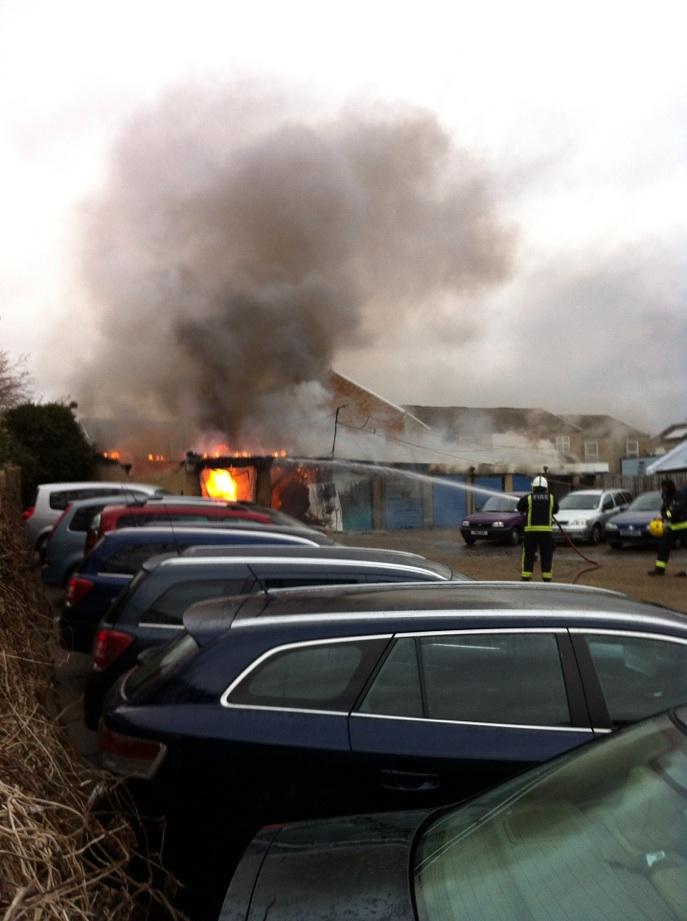
It seemed just like another ordinary working day. Everything was proceeding as normal until around 3pm the telephone at my desk rang. It was my wife Nithya. She said there was a fire at Evans Autos, a car dealership firm, very close to our house. Our road, as well as the main round around Evans Autos, was blocked off. Thick black smoke, billowing out from the fire, hung in the air around the vicinity. It was obviously a major incident. Nithya was going to take Anya, our daughter, and stay at my parents’ house. She said she would call me later when she gets more information.

Fire behind Evans Autos
My heart sank and I began to worry. Would our house be burnt down? That disastrous thought filled me with grief and anxiety. We had spent the years after getting married in that house and losing it would mean losing a great part of our life. There was nothing to do but pray quietly. I asked God for His protection. My mind disturbed and distressed was unable to concentrate again on my work. The minutes seemed to pass by a lot more slowly.

Nithya phoned again at 5pm from outside our road. Her voice sounded calm and I heard some chuckling in the background. That gave me hope that the fire was under control and our house would be saved. Nithya said she didn’t know how long it would be before our road would be opened again. So she would go back to my parents’ house and wait there.
Our house in the background
I finished work slightly earlier than usual. As I drove back home, I heard about the incident on the traffic news on the radio. That confirmed that this was a major incident. Still I was hopeful. I reached our road at 6pm. It was no longer blocked off. There was the smell of smoke all around, but seeing my house still standing and undamaged filled me with great relief. Tears of joy welled up in my eyes as I opened the front door of my house. I stood in front of the picture of Jesus in the living room and thanked Him for saving my house. It seemed like a miraculous escape.

Looking out of the window in the bedroom on the first floor, I saw how close the fire had been - just several yards away on the other side of the wooden fence at the end of the terrace. The fire had engulfed a set of small garages that had been standing there. There were still some firemen in the area making sure any remaining fire was completely extinguished.

View from bedroom window shows destroyed garages
The next day I learnt more about the incident. The fire took hold around 2.30pm, and as many as six fire engines and thirty firemen were called out to put it out. The smoke could even be seen from a few miles away. By any standards this was a major incident.

Things could have happened very differently and I could be recounting a very different tale today. For that I am grateful to the fire services and, most importantly, to God. As my neighbour commented a few days later, there really seemed to be an element of divine intervention is this incident. This only convinced us to persist with our daily Rosaries and prayers, for this world is such an unpredictable place.

Sunday, 18 March 2012

Grand Mufti of Saudi Arabia calls for the destruction of churches in the Arabian Peninsula

Can you imagine the Archbishop of Canterbury or even the Pope calling for the destruction of mosques in Europe? You can expect the predictable outcry that would cause. Most of the Muslim world and the Western media will erupt into a frenzy of heated criticism, with usual shrill cries of ‘bigot’ and demands for apologies. Yet the recent remarks by the Grand Mufti of Saudi Arabia, Sheikh Abdul Aziz bin Abdullah, that churches in the Arabian Peninsula should be destroyed have gone almost unnoticed. Only a few media organisations like Russia Today have given this any publicity.

The Grand Mufti made his controversial remarks in response to a question from a Kuwaiti NGO, the Society of the Revival of Islamic Heritage. He cited the Prophet Mohammed, who said the Arabian Peninsula should exist only under one religion. Of course, in Saudi Arabia the Mufti already has his way because there are no churches there. The Saudi government has never allowed the construction of any church in the country or for non-Muslims to meet and worship.  Other Gulf States do allow some Christian worship but with very strict restrictions in place.

What the Grand Mufti said will have an impact. He is not some marginal figure but the chief religious authority of Saudi Arabia, one of the main centres of Sunni Islam. His remarks should therefore be taken seriously.

Compare the reaction to the Grand Mufti’s remarks and the outcry over one obscure American pastor last year. It seemed as though the future of world peace was at stake when Pastor Terry Jones threatened to burn a Koran. Never mind he had a following of only about thirty people. Even Western leaders like President Obama stepped into the controversy with all the accompanying apologetic handwringing.

Can we expect David Cameron, Barrack Obama or Hillary Clinton to issue similar criticisms of the Grand Mufti’s remarks or even speak about the plight of Christians in Saudi Arabia? I doubt it very much. The American and British elites have very close relations with their Saudi counterparts, the House of Saud. In return for oil, America provides Saudi Arabia with a security guarantor; and despite a terrible human rights record, Western leaders are careful not to criticise Saudi Arabia publicly. Even the official report into the 9/11 tragedy was heavily redacted so as not to offend Saudi Arabia from where most of the hijackers came from.

All this highlights the issue of “reciprocity,” which Pope Benedict XVI has constantly talked about. As Fr Alexander Lucie-Smith says in the Catholic Herald, reciprocity means “effectively that Muslims should grant to Christians the same freedoms that Christians grant to Muslims. Just as the Italian state has allowed the building of a mosque in Rome, our holy city, so should we be allowed to build a church in Riyadh or even Mecca.”

It may be highly optimistic to expect to see a church in Riyadh or Mecca, but I don’t think it is unreasonable to at least question the controversial remarks made by the Grand Mufti. Just as Muslims are allowed to freely worship in non-Muslim countries, Christians should have every right to worship in Muslim countries.

Wednesday, 29 February 2012

Rich people less likely to be honest says study

People from wealthy backgrounds are more likely than poorer people to break laws while driving, take lollies from children, and lie for financial gain, a United States study says.

The seven-part study by psychologists at the University of California Berkeley and the University of Toronto analysed people's behaviour through a series of experiments.

For instance, drivers of expensive vehicles were observed to be more likely to break the rules at four-way intersections, and were more likely to cut off pedestrians trying to cross the street than drivers of cheaper cars.

In another test using a game of dice, given the opportunity to win a prize, people who self-reported high socio-economic status were more likely than the rest to lie and say that they had rolled higher numbers than they actually had.

People with higher status were also less likely to tell the truth in a hypothetical job negotiation in which they were the employer trying to hire someone for a job they knew was soon to be eliminated.

And when given a jar of lollies that they were told was for children in a nearby lab - though they could take some if they wanted - the richer people took more lollies than anyone else.

Also, in that particular study, researchers conditioned some of the subjects first to think of themselves as of a higher social rank by asking them to compare themselves to others with less.

The exercise showed that people could be trained to think more highly of themselves, and that they would in turn act with more greed and less ethicality, demonstrating that status drives greed.

'Culturally shared norms'

The study, which appears in the Proceedings of the National Academy of Sciences, theorises that a series of factors "may give rise to a set of culturally shared norms among upper class individuals."

For instance, richer people are more independent from others and are therefore less concerned with what others think of their actions than poorer people, the authors suggested.

According to Dr Piff, people with more money tend to look more positively on greed and rely less on family and friend networks for support in times of need, and this elevated status tends to disconnect them from society.

"It is that very different level of privilege in your everyday life that gives rise to this independence from others, this reduced sensitivity to the impact of your behaviour on others' welfare, and the prioritisation of your self-interest," he said.

Certainly there are exceptions, said the study, pointing to famous upper-class whistleblowers at Worldcom and Enron; and wealthy philanthropists such as Bill Gates and Warren Buffett.

Previous research linking poverty and violent crime also disproves the notion that all poor people are more ethical than the rich, it added.

However, self-interest is "a more fundamental motive among society's elite, and the increased want associated with greater wealth and status can promote wrongdoing," it said.

Although the study focused on US subjects, with each of the seven parts measuring between 100 and 200 participants, Dr Piff said the findings are likely to be relevant to societies outside America, too.

"These patterns are going to be particularly salient in societies where wealth is as unequally distributed as it is here," he said.

Source: ABC